Do the square when I know a side.
Construction of square whenI I know the radius.
Do the rectangle when I know two sides.
Do arectangle when I know a Diagonal and one side.
REGULAR POLIGONS
Do a regular triangle when I know one side.
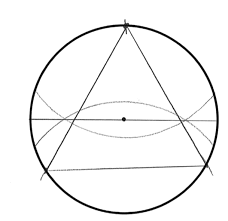
Do a regular triangle when I know the radius.
Do the rhombus when I know 2 diagonals.
Do the rhomboid when I know 2 sides and the angle A.
Do a pentagon when I know one side.
Do a pentagon when I know the radius.
Do a hexagon when I know the side.
Do a hexagon when I know the radius.
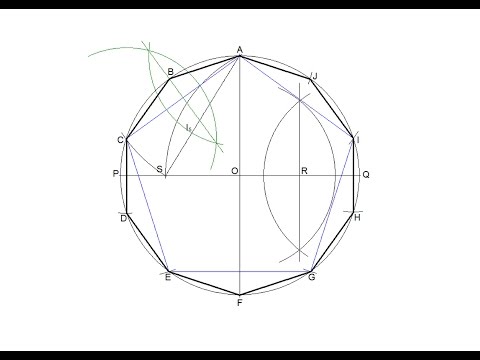
Do a heptagon when I know the radius.
Do a octogon when I know the radius. video
Do a decagon when I know the radius.
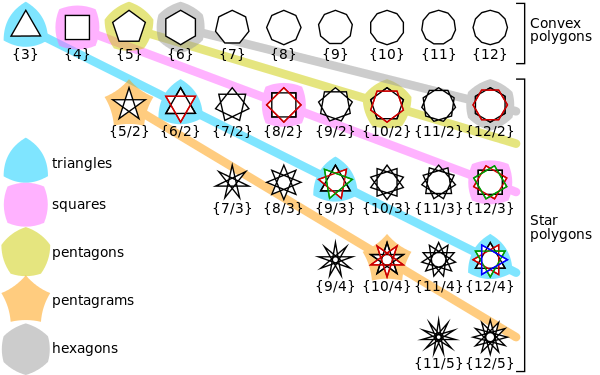
Stars polygons
BASIC ELEMENTS ET VISUAL REPRESENTATION
Symmetry: it is aqually of some shapes which some of their parts are reflections of others
Types of symmetry:
axis center
Reflection symmetry: It is a shape quality which is formed by two halves facing each other with an axis or fold line in between as if both side were mirror imagesnof each other.
Symmetry axis: It is a line which divides a shape in two aymmetry halves. Every element are the same distancefrom the axis.
Dot: It is a smallest and mot simple element in art expression. Its fiest target is to indicate a position since it doesn't follow any direction. It may have different qualities size, shape and color
The dot three dimensional capacity: When the size, shape and color are changed, the dot can create visual sensation of spacial deepress and volumen.
The dot expresive capacity: the point has a unlimited capacity to represent images and to express ideas a emotions. To do so, unusual effect are used.
Optical mix: When colors are mixed with the help of distance. Point isn't mixed on the pointing. The captical mix was used fiets by the pointillistes.
Lines: It can be definited as a dot in movement. It has position and direction in the space and one of its principal function consists on marking the shapes outlines.
- zig-zag or broke lines: They are formed by several fragments of straight lines.
- wavy line: they are formed by several fragment or curved line.
- Curly lines: they hold more curves than way lines and show lops.
- Scribed: chotic or meaningless lines that are traced randomly, usually in first stages of chifhood or to fill in some area with a particule texture.
- Hatching: It is a way of shading or giving tones to the areas of oblects or surfaces with parallel lines.
- Cross-hatching: It is a way of shading areas of a drawing or surfaces with parallel lines in several directions.
- Dashed or detted lines: they are lines which are not continuos, formed by little braces or dots.
- Blurred: They are very soft or vanished so they are hard to see and opposite to intense and deep.
Simple lines: Those that are formed by only one line.
Composite lines: They are lines composed by fragments or several straight a curved lines.
EXPRESIVE OF LINES:
- Vertical lines espressivenes: the express an ascenden movement, depending on how they are used.
- Horizontal lines espressiveness: they produced visual feelings of stability and columness or tranquility but they can be monotone if they used to much.
- Skew lines expressiveness: they produced unsteading and movement feeling; these feeling give inclined lines and sensation of dynamism.